
VISU‑FILTER 701C In‑Line Fuel Filter – 2" Universal Nylon Filter – 1/4" Fuel Line Sold Each

VISU‑FILTER 701C In‑Line Fuel Filter – 2" Universal Nylon Filter – 1/4" Fuel Line Sold Each

VISU‑FILTER 701C In‑Line Fuel Filter – 2" Universal Nylon Filter – 1/4" Fuel Line Sold Each
VISU‑FILTER 701C In‑Line Fuel Filter – 2" Universal Nylon Filter – 1/4" Fuel Line Sold Each
⚡ Low Stock — Ships Same Day
OVERVIEW
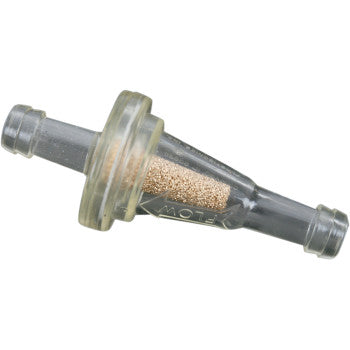
The VISU‑FILTER 701C inline fuel filter stabilizes fuel delivery and protects carbureted engines from abrasive contaminants. Built with a high‑impact nylon housing and sonically sealed seams, this compact component maintains consistent flow while securing directly onto 1⁄4″ tubing. Designed specifically for powersports machinery such as ATVs, it provides a straightforward replacement point for routine maintenance or system upgrades.
ENGINEERING & PERFORMANCE
A straight‑through internal pathway pairs with standard paper media to deliver uninterrupted fuel movement without restricting pressure. The welded nylon shell resists impact damage and vibration fatigue, eliminating leak points that commonly develop in lower‑grade plastic filters. The fully transparent exterior supports immediate visual diagnostics, allowing operators to monitor fluid clarity and trap efficiency before performance issues arise.
KEY FEATURES
- 2‑inch compact inline form factor
- High‑impact nylon construction
- Sonically welded body joints
- Clear transparent housing for rapid inspection
- Internal paper filtration media
- Metric and imperial sizing rated for 1/4″ (6.4 mm) line
- Straight‑through fluid routing design
- Engineered for carbureted small‑engine operation
- Cross‑references 8420 and 01‑9909 designs
TECHNICAL SPECIFICATIONS
- Brand: VISU‑FILTER
- Part Name: 701C In‑Line Fuel Filter
- Component Type: Inline Fuel Filter
- Housing Material: High‑Impact Nylon
- Fuel Line Compatibility: 1/4″ (6.4 mm)
- Body Length: 2 inches
- Equivalent Standards: 8420 / 01‑9909
FITMENT
- Universal — fits most motorcycle, ATV, UTV, snowmobile, and watercraft fuel-system applications requiring a 1/4″ inline configuration.
WHY RIDERS CHOOSE THIS
Operators prefer this filter because the clear polycarbonate‑style body turns routine maintenance into a quick visual check instead of a scheduled guess. The direct linear flow layout prevents restrictive choke points, keeping carburetor needles fed evenly during hard acceleration and steep climbs. Sealed manufacturing steps eliminate weak joints that commonly fail under dust, mud exposure, or prolonged engine vibration. Because it aligns precisely with standard 1/4″ plumbing, it drops into legacy and modified fuel racks without adapters or custom cutting.
Couldn't load pickup availability
- Family-Owned Powersports Shop Since 2007
- Fast Shipping From Tennessee
- Authorized Dealer for most Powersports major brands
- 10% Off Storewide (Auto Applied at Checkout)
- No Amazon/eBay Knockoffs
- Real Customer Service From Real Riders
🔥 Top Sellers — Carburetor Rebuild Kits
-
Shindy 03‑210 Carburetor Rebuild Kit – Suzuki LT80 QuadSport 1987‑2006 (Made in Japan)
Regular price $23.70 USDRegular price -
Moose Racing Carburetor Rebuild Kit – Honda TRX300 / TRX300FW 1991‑2000
Regular price $38.33 USDRegular price -
Shindy Carburetor Rebuild Kit for Kawasaki Mule 610 / KAF400 / SX (2007‑2019) – Made in Japan – Complete Carb Repair Kit
Regular price $25.60 USDRegular price -
Shindy Carburetor Rebuild Kit 03‑216 – Suzuki Vinson 500 LT‑A / LT‑F (2002–2007) – Made in Japan
Regular price $35.10 USDRegular price


